

illumind
illumind
FigBuild 2026
ROLE
Product Designer
TEAM
2 Designers
TIMELINE
March 2026 (36 Hours)
the challenge
For FigBuild 2026, I teamed up with another designer to address the prompt: “Identify something intangible, invisible, or previously unmeasurable about the human sensory experience and design a speculative tool to track and influence it.” Over a 3-day sprint, we carried out user research, iterations, and delivered a final working prototype in Figma.
what is illumind?
Short-form video content encourages constant scrolling and passive consumption, but we don’t know how much our cognition changes when using our devices.
What if we could see how our minds respond to our devices in real time? What if we could understand when we go from learning to mindlessly scrolling? The first step in changing habits comes from awareness.
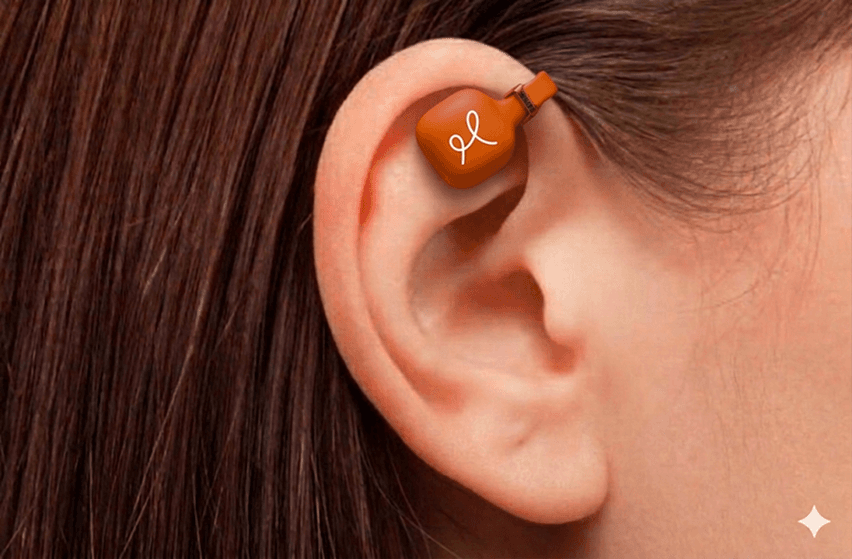
Illumind is a mobile app paired with a wearable device that measures and visualizes your cognitive state in real time.
defining our direction
We chose to track a sense we deemed as “metacognitive awareness”. This is the ability to perceive the quality and state of your own thinking.
The Two-Part Product
Just tracking scrolling speed, typing rhythm, and other signals from your device to make assumptions about an individual’s state of mind needed more evidence to draw insights. We decided to include a wearable device that tracks your real-time brain waves, combined with signals from your device.
the problem
Digital consumption is increasing, which means it shapes our minds more than ever before. Attention span among all ages have been decreasing, and with the rise of “doomscrolling”, how can we accurately track our cognitive states from the impact of devices and screen time? Illumind uses multiple streams of tracking to make inferences and gently remind the user of their real time cognitive state.

physical exercise + movement
app switching frequency

typing rhythm
scrolling speed
illumind’s cognition score
brainwave frequency from a wearable device


the solution
We believe that most of our users suffering from attention fragmentation are likely to start off at a low score, and gentle reminders and notifications through insights is how we get their cognition score up and serve retention.
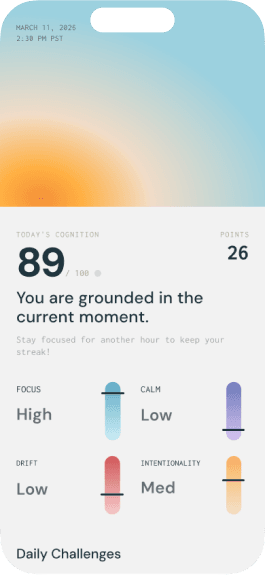
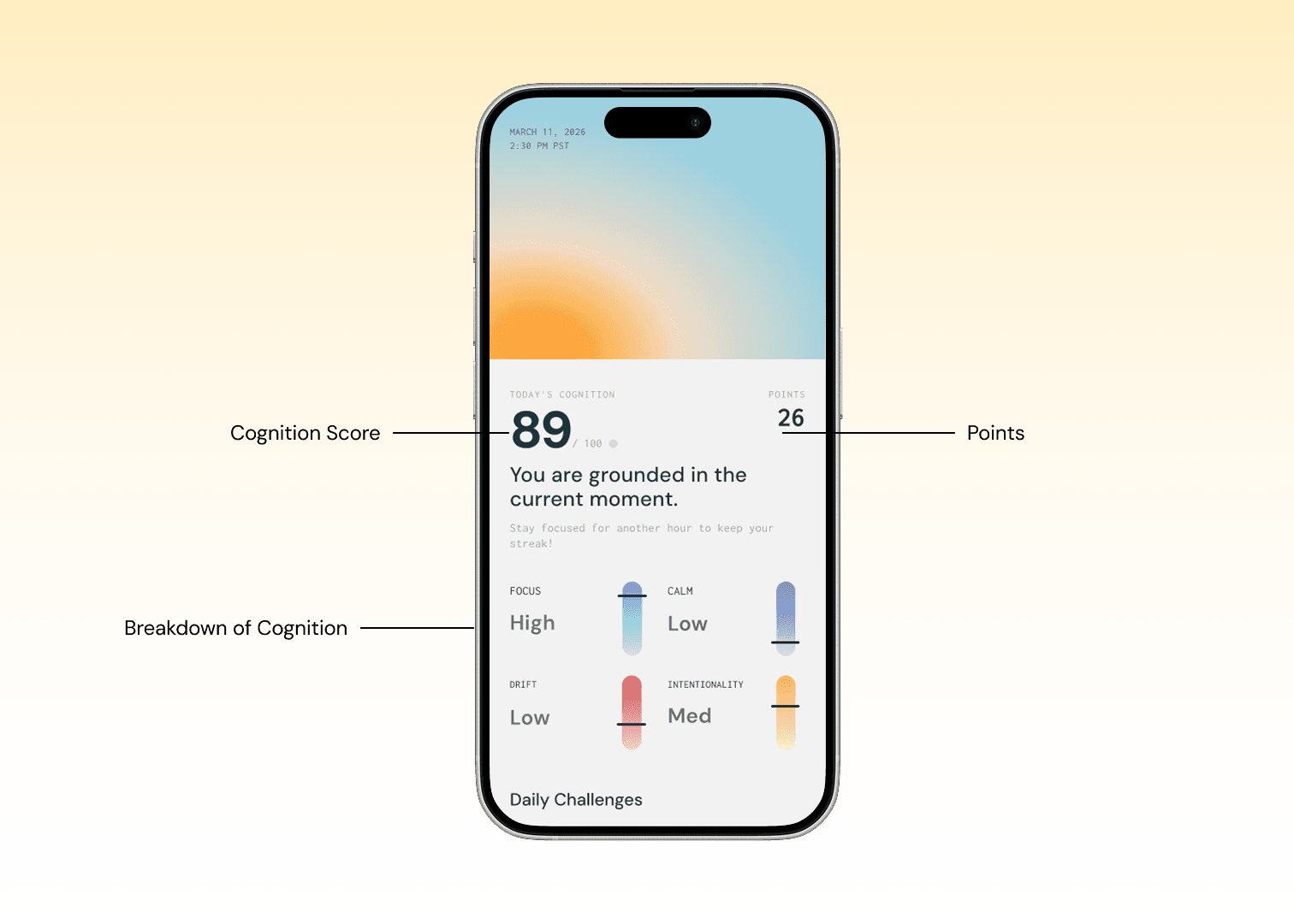
The user starts off at the home page with an real time cognition score, broken down into four categories that make up the score: focus, calm, drift, and intentionality. Daily Challenges are personalized based on the users’ cognition score, encouraging activities such as physical activity that would improve their cognition score.
Cognitive Tracking in Home Page
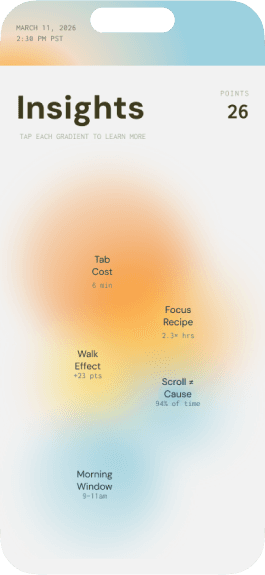
The insights page and the timeline allow users to gain awareness of their cognition throughout the day.
My Mind Timeline
Insights
The habits tracker uses a point and streak system to incentivize users to improve their cognition score, as well as providing monthly insights and graphs for an overarching viewpoint of the users’ cognition.
Habits Tracker in Profile
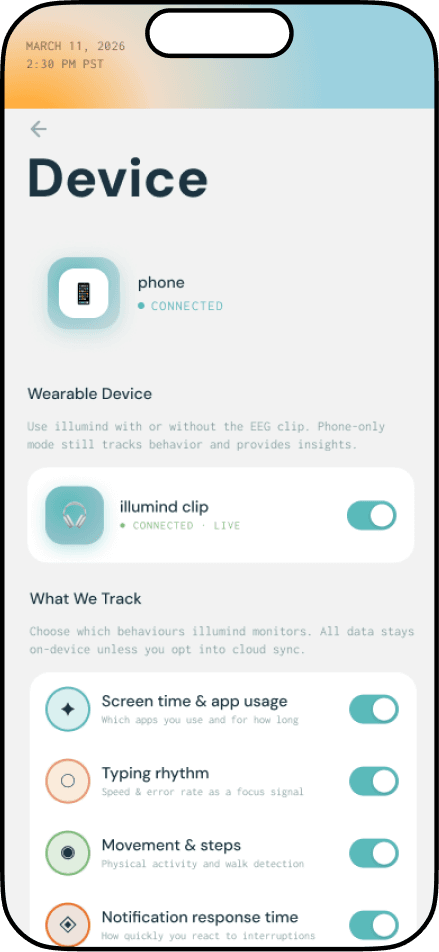
EEG data is sensitive information. Our users can turn on and off privacy anytime.
reflections
One of our biggest challenges was how to present the data in a digestible way that would not overwhelm or confuse the users. So many streams of data led us through numerous iterations of how the insights page would be designed, as well as how to encourage users to improve their habits through a point system.
Overall, I learned that the simplest design is the best for the user, and pondered about how to make the design even simpler while conveying information in an accurate and pleasing way. Chat with me about this project in the contacts below!